Focus
- 2025-10-01
- Source: 金风科技
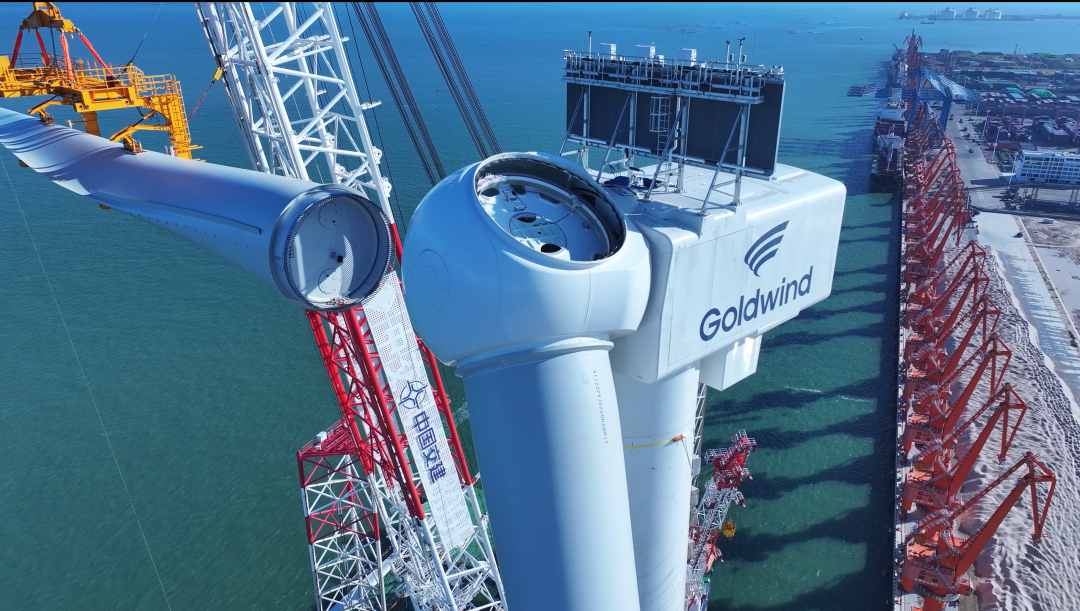
On October 1, 2025, the GWH252-16-F floating wind turbine, jointly developed by Goldwind and China Three Gorges Corporation, was successfully installed in Beihai, Guangxi. The turbine sets multiple new world records for the largest single-unit capacity and the largest rotor diameter among installed floating offshore wind turbines. Its key components have all been fully localized. The turbine is expected to generate 44.65 million kilowatt-hours of electricity annually - enough to meet the annual power needs of more than 24,000 three-person households.
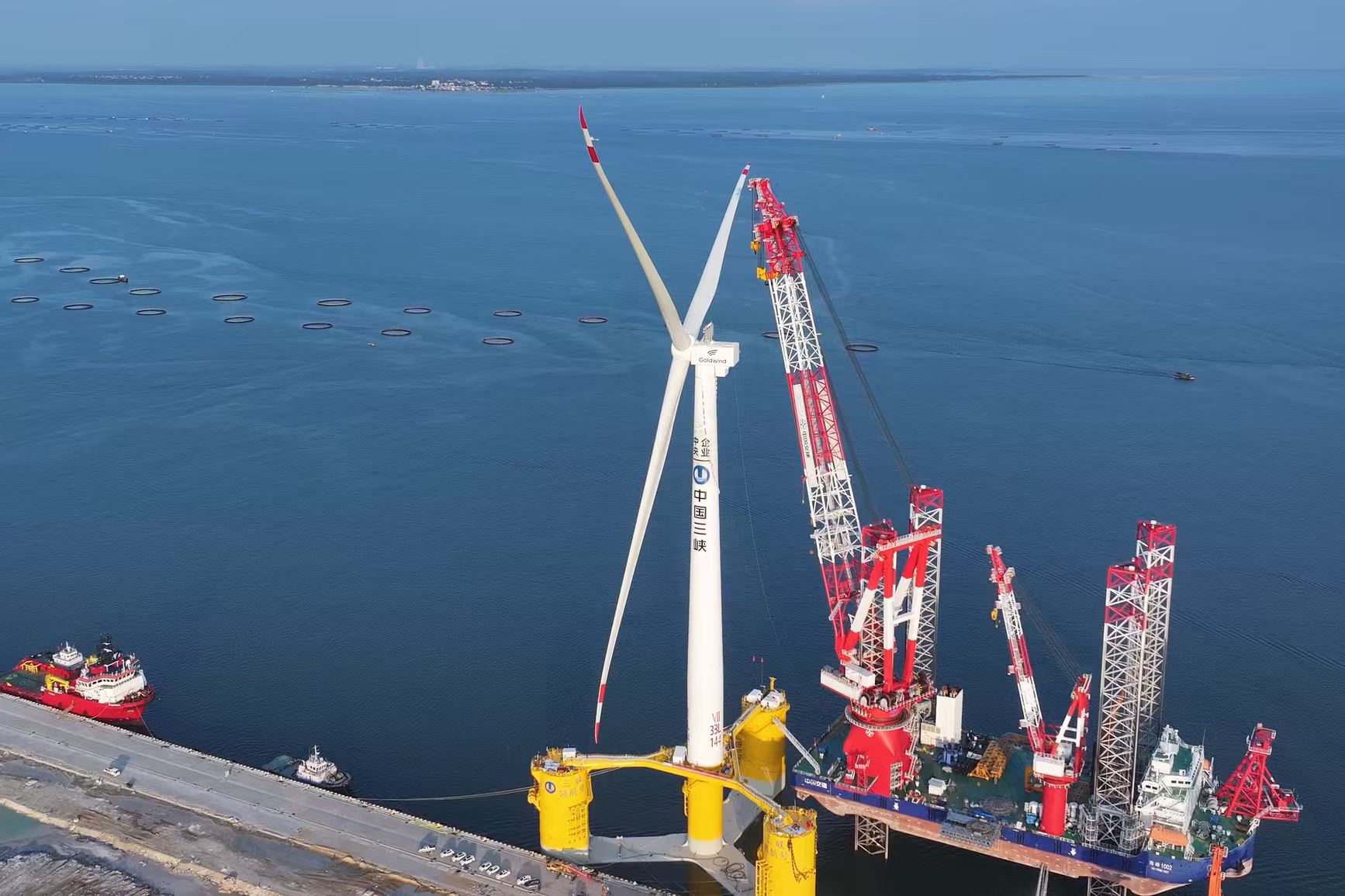
China's technically developable deep-sea wind power resources exceed 1.2 billion kilowatts, with wind energy reserves in waters deeper than 50 meters being two to three times those of nearshore areas. Floating offshore wind turbines are supported by floating platforms that allow them to operate on the open sea, overcoming the limitations of fixed-bottom turbines that can only be installed in nearshore waters. They serve as a powerful tool for unlocking deep-sea wind energy resources.
At present, the wind power industry has carried out a series of explorations in the field of floating offshore wind power, but due to the high difficulty of technology validation, it remains at the pilot application stage and has yet to enter full commercial deployment. The GWH252-16-F turbine installed this time is an upgraded floating-platform version developed based on Goldwind's commercially deployed GWH252-16MW turbine. By efficiently reusing core components, the design achieves significant cost reductions across the entire lifecycle from design and manufacturing to operation and maintenance. Building on previous application experience, the turbine underwent more than 10,000 load simulation conditions during the design phase, enabling "genetic optimization" and substantially enhancing product reliability.
High development costs remain the core obstacle to the commercial deployment of floating offshore wind turbines. Statistics show that as of 2024, the unit cost of floating wind projects in trial operation worldwide generally exceeds CNY 30,000 per kilowatt, nearly three times that of fixed-bottom offshore projects. Therefore, overcoming economic bottlenecks is the key breakthrough for enabling floating wind power to "move from pilot demonstrations to large-scale industrial development".
As the world's largest floating wind turbine by single-unit capacity, the GWH252-16-F can effectively reduce the overall development cost of floating wind projects by spreading fixed costs over greater capacity. It also minimizes sea area usage, lowers engineering and O&M costs, and improves the overall economic performance of floating wind power. Through joint efforts between Goldwind, China Three Gorges Corporation, and other industry partners, system-level simulations covering the "turbine, floating foundation, and mooring system" were conducted to achieve an "integrated design" for the floating turbine. An "integrated control system" linking the wind turbine and the floating platform was developed, significantly reducing design redundancy, overcoming the challenges of load control for floating turbines, and paving a feasible path for the industrial-scale application of large floating wind power.
In addition, through intelligent and adaptive upgrades, the turbine demonstrates strong "survivability". It adopts RTK (Real-Time Kinematic) dynamic positioning technology to enable high-precision real-time monitoring of turbine posture, providing intelligent early warnings and decision support for predictive maintenance, thereby enhancing the reliability of floating turbines. To address the weak offshore grid conditions, the turbine is also equipped with a self-contained generator that enables "black start" capability, allowing continued operation even when disconnected from the grid. The turbine can operate stably in extreme temperatures as low as -20°C and is designed to withstand super typhoons of up to level 17. It is suitable for wide deployment across China's southeastern coastal regions, countries along the Maritime Silk Road, and offshore areas in Europe and North America.
The GWH252-16-F turbine is now fully assembled and ready for deployment. After several days of towing operations, it will arrive at its designated site in the offshore waters of Yangjiang, Guangdong, officially beginning operation. In the course of its operation, it will open up new pathways for the utilization of deep-sea wind energy resources.
-

Goldwind Official WeChat Account
- 中